Skip to content
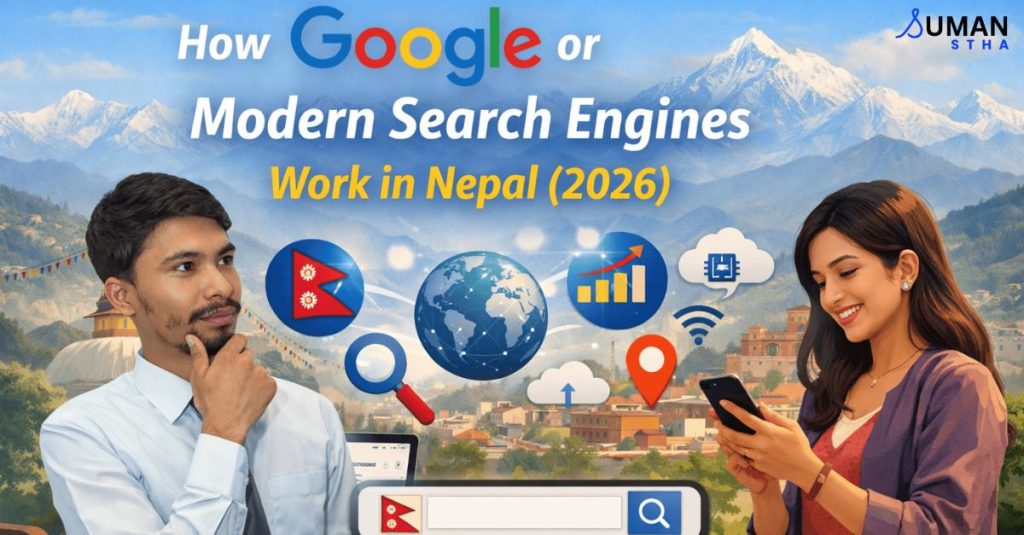
To understand how modern search engines or Google work in 2026, you must look beyond traditional “blue links.” Search engines are now sophisticated AI-driven ecosystems that prioritize real-world experience and localized context.
Search engines operate through a four-stage lifecycle:
-
Crawling: Bots (spiders) discover your code and content via links.
-
Indexing: Google analyzes your page’s “Entities” (topics, locations, and data) and stores them in a massive database.
-
Generative Synthesis: AI models (like Gemini) synthesize your data to provide instant “AI Overviews” or “Zero-Click” answers.
-
Ranking: Algorithms rank your site based on E-E-A-T (Experience, Expertise, Authoritativeness, and Trustworthiness) and proximity to the user.
To rank in Nepal today, your content must be optimized not just for keywords, but as a “source of truth” that an AI can confidently cite for local queries.
Here is the detailed explanation of Google or modern search engine working process, explained in simple way:
1. Discovery and Crawling: Navigating Nepal’s Digital Infrastructure
Crawling is the foundation of visibility. If Googlebot cannot access your site, you don’t exist in search. In Nepal, where internet infrastructure transitions from Kathmandu’s high-speed fiber to fluctuating 4G/5G in rural provinces, Crawl Efficiency is your first hurdle.
Technical Foundations for Crawlability
If your server whether hosted locally or on a global cloud—is sluggish, Googlebot will hit its “Crawl Budget” and leave before indexing your deep pages.
-
Mobile-First Indexing: Over 85% of Nepali users are on mobile. Google’s 2026 guidelines mandate a Largest Contentful Paint (LCP) of under 1.2 seconds for mobile users.
-
The Robots.txt Safety Net: Use this file to prevent bots from wasting time on junk URLs (like internal search result pages), but ensure you aren’t blocking the JavaScript files needed to render your site’s layout.
Strategic Internal Linking
You must guide bots through a logical hierarchy. For example, this technical deep-dive is a “cluster” designed to strengthen our Ultimate Guide to Search Engine Optimization. By linking back to a pillar, you signal to Google that your site has deep expertise in the “SEO” topic or detailed fundamentals of SEO.
2. Indexing and Semantic Understanding: Beyond Keywords
Once discovered, your page is added to the Search Index. In 2026, Google has moved away from matching strings of text to understanding Entities.
The “Helpful Content” Indexing Filter
Google now uses an AI-powered filter during the indexing phase. If content appears to be mass-produced AI text without “Information Gain” (new facts or perspectives), it is often relegated to “Discovered – currently not indexed.” To pass this filter, you must offer unique value—like local case studies or original data from the Nepali market.
Use Case: Localized Schema for High-Confidence Indexing
To get a business in Nepal indexed for “near me” searches, you must use JSON-LD Schema Markup.
Example: Based on my direct experience working with trekking agencies in Nepal, a Thamel-based trekking company implemented Review and LocalBusiness schema with verified 5-star ratings and a real physical address. When travelers search for “Best Everest Base Camp Trek,” Google doesn’t just read page content, it recognizes a legitimate local trekking operator with proven on-ground experience, making the page a high-confidence, EEAT-aligned candidate for top rankings and AI search results.
3. Generative Synthesis: The AI Overview Layer

The newest stage of search is Generative Synthesis. This is where Google’s Gemini model reads your indexed content to answer a user’s question directly on the search page.
-
Becoming a Source of Truth: AI Overviews favor content that uses clear, declarative sentences.
-
Information Gain: If your blog provides the exact price of an SEO audit in NPR (Nepalese Rupees) while competitors are vague, the AI is more likely to cite your site as the authoritative source.
4. Ranking Factors: E-E-A-T and Local User Intent
Ranking is the final decision on which page solves the user’s problem best. In 2026, the ranking algorithm is a collection of AI systems like RankBrain and MUVERA.
The Evolution of E-E-A-T
-
Experience: Does your content include original photos of your work or office in Nepal?
-
Expertise: Is the author a verified professional with a linked LinkedIn profile and a history of publishing on the topic?
-
Trust: Does your site have an HTTPS certificate, a clear “About Us” page, and transparent contact information?
Search Intent in the Nepali Context
Intent is often tied to location and currency. A user in Lalitpur searching for “Internet Provider” wants local packages, not a global list. If your content doesn’t mention specific districts, local payment methods (eSewa/Khalti), or local pricing, you will be outranked by competitors who provide that granular detail.
Actionable Steps: How to Optimize for Modern Search

-
Submit a Clean XML Sitemap: Ensure your sitemap only includes high-quality, “200 OK” pages. Submit this to Google Search Console (GSC) monthly.
-
Optimize for “Zero-Click” Results: Use your H2s as questions (e.g., “How much does SEO cost in Nepal?”) followed immediately by a concise 40-50 word answer.
-
Improve Core Web Vitals: Use a CDN to ensure your site loads fast for users in remote areas like Mustang or Solu-Khumbu.
-
Strengthen Topical Authority: Always link your cluster articles back to your Main Pillar Page (as i linked to ultimate guide to SEO above) to show Google you own the entire subject.
Common Questions About Search Engine Mechanism
You can find more other queries people are search about search engine algorithms working process;
1. How does Google handle Nepali and “Romanized” Nepali content in 2026?
Google’s Multitask Unified Model (MUM) now understands the nuances of the Nepali language better than ever. It can recognize the same intent whether a user types in Devanagari (e.g., “उत्तम कफी पसल”), Romanized Nepali (e.g., “Ramro coffee pasal”), or English (“Best coffee shop”).
To rank best, use a bilingual approach. Include your primary keywords in both English and Devanagari in your Meta Tags to capture the full spectrum of local search behavior.
2. What is “Zero-Click Search,” and will it kill my website traffic?
A “Zero-Click Search” happens when Google’s AI Overview or a Featured Snippet answers the user’s question directly on the search page, so they don’t need to click your link.
While clicks for simple “definitions” may drop, traffic for “decision-making” queries (like “Best trek for beginners in Nepal”) is becoming more valuable. Users who do click are further along in the buying journey.
3. Can I use AI like ChatGPT or Gemini to write my SEO content in 2026?
Yes, but with a major caveat. Google’s 2026 “Helpful Content” systems can easily detect mass-produced, generic AI text.
Use AI to outline or research, but always inject Personal Experience. Add original photos from your office in Kathmandu, unique client case studies, or your specific opinions on the Nepali market to pass the E-E-A-T check.
4. How do I get my business into the “Google Map Pack” in Nepal?
Local SEO is the most effective way to drive foot traffic. Google prioritizes NAP Consistency (Name, Address, Phone Number).
Ensure your details are identical on Google Business Profile, Facebook, and local directories like Yellow Pages Nepal or Hamro Patro. In Nepal, where addresses are often vague, use the “Plus Code” or a precise map pin to help Googlebot verify your exact location.
5. Does the “.com.np” domain help with ranking in Nepal?
While a .com.np domain is a strong signal of local relevance, Google primarily looks at the server location and user proximity.
A .com domain can rank just as well if your site is fast and your content mentions local landmarks and uses Nepali currency (NPR). However, a .com.np is free and serves as an immediate trust signal to local users.
6. Why is my site not ranking despite having “perfect” keywords?
In 2026, User Experience (UX) is a massive ranking factor. If your site is cluttered with ads or takes more than 2 seconds to load on a 4G Ncell/NTC connection, your rankings will suffer regardless of your keywords.
Open your site on a mobile device. If it’s hard to navigate with a thumb or the text is too small, Google’s “Page Experience” algorithm will likely demote you.
7. How long does it take for Google to index my new page in Nepal?
Usually 24 hours to a week. Use the “URL Inspection” tool in GSC to request a crawl. For time-sensitive news, the Google Indexing API provides near-instant discovery.
8. Why did my ranking drop after a Google Core Update?
In 2026, updates target “Site Reputation Abuse” and AI-spam. If your site lacks a clear human author or uses “thin” content, your rankings may be demoted in favor of trustworthy, expert-led sources.
9. Does social media activity affect how search engines work?
Social media isn’t a direct ranking factor, but it creates Brand Signals. When Nepali users search for your brand name after seeing a viral post on TikTok or Facebook, Google recognizes you as a “Prominent Entity,” which can boost your overall search authority.