
E-commerce SEO in Nepal means optimizing your online store to rank higher on Google without paying for ads. Nepal’s e-commerce market generated US$889 million in revenue in 2024 (Source: eCommerceDB), with Statista projecting it to reach US$1.38 billion through 2025–2026 and grow to US$3.94 billion by 2029 at a CAGR of 28.6%. Organic search drives 35–45% of all e-commerce website traffic (Source: Firewire Digital, 2025), making SEO the most cost-effective and compounding growth channel for Nepali online stores.
Why is E-commerce SEO Essential for Nepali Online Stores?
E-commerce SEO is very important for Nepali Online Stores because:
- Nepal’s digital commerce market is growing at a CAGR of 28.6%, reaching an estimated US$3.94 billion by 2029.
- Over 95% of internet access in Nepal is mobile-driven, meaning your store must be mobile-optimized to rank and convert.
- Organic traffic compounds over time, unlike paid ads, SEO investments keep delivering results months and years after implementation.
- Daraz, SmartDoko, and SastoDeal dominate category-level searches today — but niche stores with strong SEO can carve out profitable organic traffic in their specific product verticals.
Nepal’s e-commerce landscape shifted dramatically post-COVID. Consumers from Kathmandu to Pokhara now rely on Google to discover products before purchasing. If your store doesn’t appear on the first page of search results, you’re effectively invisible to a customer actively looking to buy what you sell.
The good news: organic competition in Nepal’s e-commerce space is still relatively low compared to India or the US. A focused SEO strategy built on the right foundations can deliver first-page rankings faster and at a fraction of the cost of paid advertising.
What Keyword Strategy Works Best for E-commerce SEO in Nepal?
Some keyword strategy best practices for e-commerce SEO in Nepal, such as:
- Target Nepali buyer-intent keywords — phrases like “buy laptop in Nepal,” “mobile price in Nepal,” or “iPhone online Nepal.”
- Use long-tail keywords to capture high-converting traffic with lower competition (e.g., “best gaming laptop under 80000 in Nepal”).
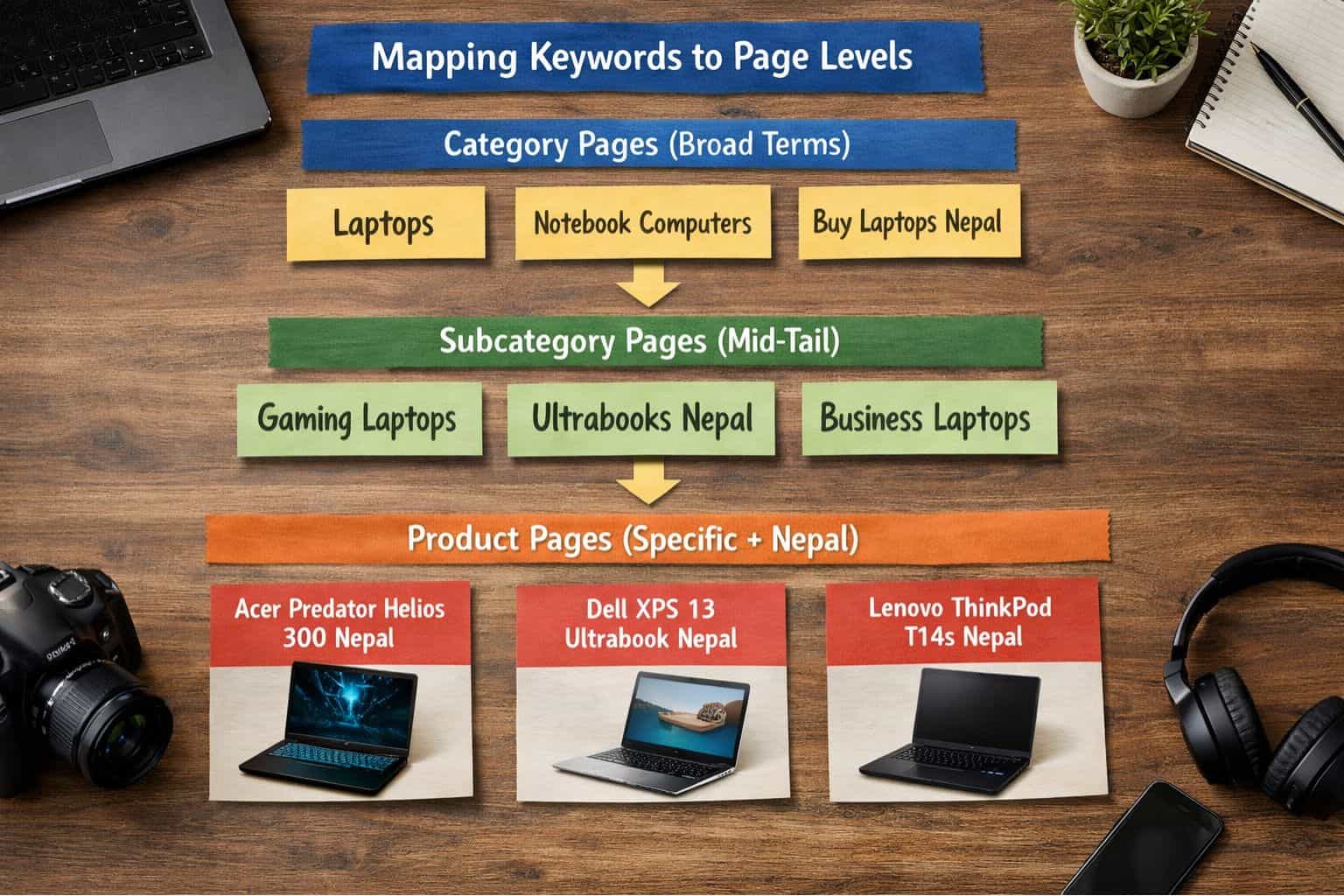
- Map keywords to three levels: category pages (broad terms), subcategory pages (mid-tail), and product pages (specific model + Nepal).
- Include Nepali-language search terms where relevant — Devanagari searches are growing as rural internet adoption increases.
Tools like Google Search Console, Ubersuggest, and Ahrefs Free can reveal what search terms your existing visitors already use. For most Nepali e-commerce stores, the highest-value opportunity lies in product-specific queries — searches where the user has already made a purchase decision and just needs to find a trustworthy seller.
A critical gap in most Nepali store SEO: ignoring seasonal keyword spikes. Searches for electronics spike around Dashain-Tihar, fashion and gifts around Valentine’s Day, and agricultural tools during planting seasons. Building content calendars around Nepal’s cultural calendar can deliver significant organic traffic surges that competitors miss entirely.
How Should You Optimize Product Pages for Google Rankings?
Here is how to optimize product pages for Google rankings:
- Write unique product descriptions — never copy manufacturer text, which creates duplicate content penalties.
- Include the primary keyword in the
<title>tag, H1 heading, first 100 words of the description, and image alt text.
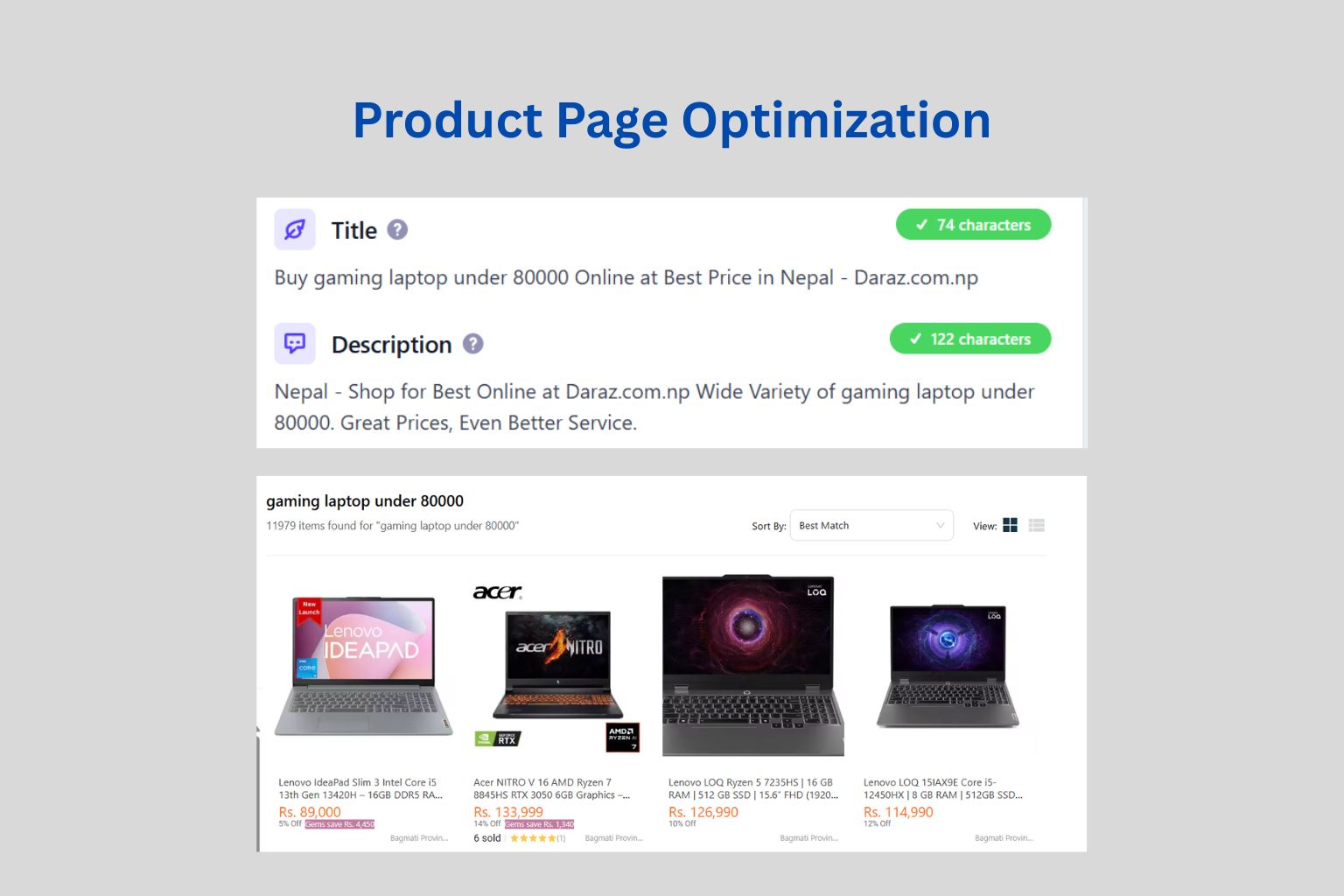
- Add structured data (Product Schema) to display star ratings, price, and availability directly in Google search results.
- Compress all product images and use descriptive file names (e.g.,
gaming-laptop-under-8000-nepal.jpg).
Most Nepali e-commerce stores make the same critical mistake: they use placeholder manufacturer descriptions copied from supplier catalogs. Google strongly discourages thin, low-quality content — and these pages rarely rank. Instead, write 150–300 words per product page that answer the buyer’s real questions: What makes this product worth buying? How does it compare to alternatives? What does it cost and when will it arrive?
Product pages with customer reviews also rank significantly better. Reviews generate unique user-generated content naturally, adding new keyword-rich text to your page every week without additional writing effort.
How Does Technical SEO Impact an Online Store in Nepal?

This is how technical SEO impacts an online store in Nepal:
- Site speed is critical — Google’s Core Web Vitals directly influence rankings. Compress images, enable browser caching, and use a fast hosting provider.
- Implement an SSL certificate (HTTPS). Google flags HTTP sites as insecure, which reduces both rankings and conversions.
- Fix crawl errors in Google Search Console — broken links, 404 pages, and duplicate URLs all waste your crawl budget.
- Use a clear URL structure:
yourstore.com/category/subcategory/product-name— Avoid long parameter strings like?id=4592.
One area most competitor articles ignore: server location matters for Nepali stores. Hosting your site on servers physically located in or near Nepal (or using a CDN with South Asian PoPs) can significantly improve page load times for Nepali users — and faster load times mean better rankings and fewer abandoned carts.
Nepal’s internet infrastructure has improved markedly, but many rural users still connect via 3G or 4G mobile networks. A store that loads in 2 seconds on fiber may take 8 seconds on mobile data — optimizing for low-bandwidth scenarios is a competitive advantage most Nepali stores overlook.
What Content Strategy Grows Organic Traffic for Nepali E-commerce Sites?
Here is the content strategy to grow organic traffic for Nepali e-commerce sites:
- Build a blog or resource section targeting informational keywords your buyers search before purchasing (e.g., “best smartphones under NPR 30,000 in Nepal 2025”).
- Create buying guides, comparison articles (“Daraz vs SmartDoko — Where to Buy Electronics in Nepal”), and how-to content related to your products.
- Target “near me” and location-specific content — “buy handmade dhaka fabric online Nepal” or “order organic tea from Ilam.”
- Use FAQ sections on category and product pages to capture featured snippet positions.
Content marketing is the highest-ROI long-term strategy for Nepali e-commerce stores. Apparel is the largest e-commerce category by store count in Nepal (423 stores), yet most of these stores publish no content at all. A fashion store that publishes guides like “How to Style Dhaka Fabric for Modern Wear” or “Traditional Newari Jewelry Guide” can rank for dozens of high-intent keywords with zero paid promotion.
How Important Is Local SEO for E-commerce Stores in Nepal?
Nepali e-commerce stores also get benefits from Local SEO. Here are the best practices of local SEO for online stores:
- Set up and fully optimize your Google Business Profile — even e-commerce stores benefit from local search visibility.
- Build local citations on Nepal-specific directories: Nepal Yellow Pages, hamrobazar.com, and local chamber of commerce listings.
- Include your city or region in metadata — “Online electronics store in Kathmandu” signals local relevance to Google.
- Collect and respond to Google reviews — they build trust with both search algorithms and Nepali buyers who value social proof before making an online purchase.
Kathmandu accounts for 53% of e-commerce activity in Nepal, making it the most competitive market. However, stores targeting cities like Pokhara, Biratnagar, and Chitwan face far less SEO competition — and these markets are growing as internet penetration spreads beyond the valley. Targeting city-specific landing pages (“electronics store Pokhara” or “online grocery delivery Chitwan”) can be a quick win for stores with nationwide delivery capability.
What Link Building Strategies Work for Nepali E-commerce Stores?
- Guest post on Nepal’s popular blogs and news sites (e.g., The Himalayan Times Online, Onlinekhabar, Setopati) with backlinks to your store.
- Partner with Nepali YouTube channels and influencers who review products — video descriptions with links pass SEO authority.
- List your store in Nepal-specific business directories and industry associations.
- Create linkable assets: original data reports on Nepal e-commerce trends, infographics about local consumer behavior, or comprehensive buying guides that other sites will reference.
The Nepal E-commerce SEO Growth Framework
Most SEO guides for Nepal repeat the same generic advice. What’s missing is a sequenced growth framework tailored to the realities of Nepal’s market — limited budgets, mobile-first users, and low domain authority for most new stores.
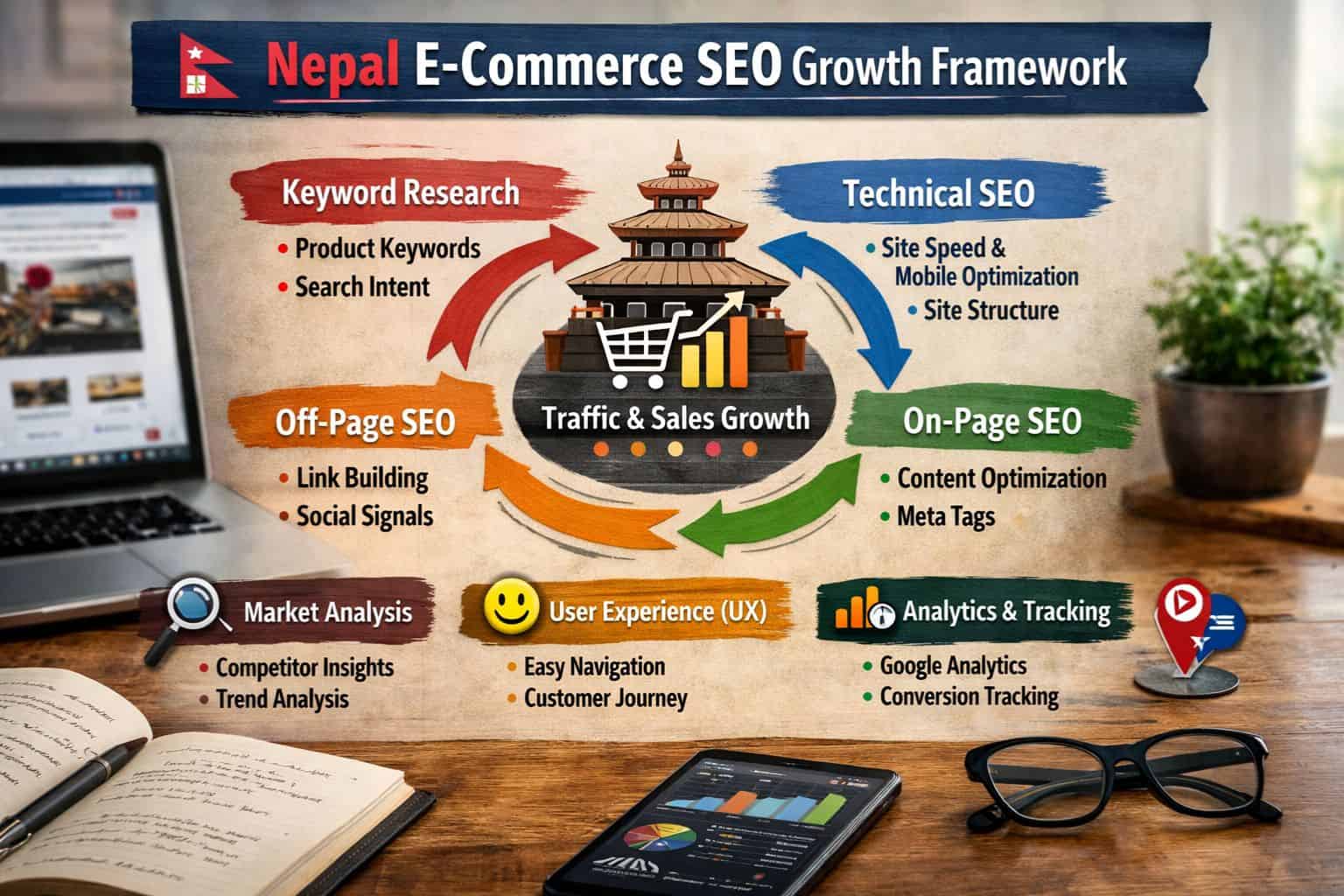
Here is the NEST Framework (Nepal E-commerce SEO Traction), a phased approach:
Phase 1 — Foundation (Months 1–2): Fix technical SEO issues. Set up Google Search Console and Analytics. Write unique descriptions for your top 20 best-selling products. Submit a sitemap.
Phase 2 — Traction (Months 3–5) Target 10–15 long-tail buyer-intent keywords. Optimize category pages. Build 5–10 quality backlinks through local directories and guest posts. Publish 2 buying guides per month.
Phase 3 — Authority (Months 6–12) Scale content production. Target competitive head keywords. Build links through PR, influencer collaboration, and original research. Implement Product Schema across the entire catalog.
Phase 4 — Compounding (Year 2+) Existing content accumulates authority and rankings. Reinvest traffic data to identify new keyword opportunities. Localize content for non-Kathmandu markets.
Stores that follow this sequence consistently have seen organic traffic growth of 200–300% within the first year — without a single rupee spent on Google Ads. The key is sequencing: most stores fail because they skip Phase 1 (technical SEO) and invest in content before their site is technically sound.
The Summary of E-commerce SEO in Nepal
E-commerce SEO in Nepal is one of the highest-ROI growth strategies available to online stores in 2025 and beyond. With the market projected to reach US$1.38 billion this year and digital commerce growing at 28.6% annually, organic search positioning is becoming a critical competitive asset — not an optional marketing channel.
The path forward is clear: fix your technical foundation, build product pages that answer buyer questions, create content that captures demand before it reaches competitors, earn quality backlinks from trusted Nepali sources, and optimize for mobile-first users who dominate Nepal’s internet landscape. Follow the NEST Framework sequentially, measure results monthly in Google Search Console, and compound your gains over time.
The stores that invest in organic SEO today will dominate Nepal’s digital commerce landscape tomorrow.
If you prefer to save time and avoid the complexities of SEO, consider hiring a professional e-commerce SEO specialist in Nepal.
Additional Sources:
- Nepal’s e-commerce market generated US$889 million in revenue in 2024 — Source: eCommerceDB
- Nepal’s digital commerce market is growing at a CAGR of 28.6%, projected to reach US$3.94 billion by 2029 — Source: Statista — Digital Commerce Nepal
- Nepal has 16.6 million internet users (56% penetration) with 32.4 million mobile connections — Source: DataReportal — Digital 2026: Nepal
- 43% of all e-commerce traffic comes from organic Google search, making it the single largest traffic channel for online stores — Source: Reboot Online — Ecommerce SEO Statistics
Frequently Asked Questions About Online Store in Nepal
Here are the commonly asked questions regarding the online store in Nepal:
1. How long does E-commerce SEO take to show results in Nepal?
E-commerce SEO in Nepal typically shows measurable results within 3–6 months for long-tail keywords and 6–12 months for competitive category terms. The timeline depends on your site’s existing authority, competition level in your niche, and how consistently you implement on-page and off-page optimization. Stores with existing domain history tend to see results faster than brand-new sites.
2. Is Nepali-language (Devanagari) SEO worth investing in for e-commerce stores?
Yes, increasingly so. As internet adoption spreads to rural Nepal, more users search in Nepali rather than English. For product categories targeting non-urban consumers — agricultural tools, regional food products, traditional crafts — Devanagari keyword targeting can unlock an underserved audience with minimal SEO competition. Start by translating your top product pages and tracking performance in Google Search Console.
3. What are the most important SEO tools for Nepali e-commerce businesses?
Google Search Console (free, essential) and Google Analytics (free, essential) should be your foundation. For keyword research, Ubersuggest and Google Keyword Planner offer free tiers suitable for most small stores. Ahrefs or SEMrush is worth the investment once you’re generating consistent revenue and want to scale more aggressively.
4. How does mobile optimization affect e-commerce SEO in Nepal?
Critically. Over 95% of internet access in Nepal is via mobile devices. Google uses mobile-first indexing, meaning it evaluates your mobile site performance to determine rankings for all devices. If your store is slow, difficult to navigate on a smartphone, or has buttons too small to tap accurately, it will rank lower regardless of your content quality. Mobile speed and usability are non-negotiable for Nepali e-commerce SEO.
5. Should Nepali online stores focus on Daraz or build their own SEO-optimized store?
Both serve different purposes. Daraz offers immediate marketplace visibility but you’re renting an audience, not building one. Your own SEO-optimized store builds a long-term asset — traffic that compounds without additional spend. The most resilient Nepali e-commerce businesses operate on both: using Daraz for reach and their own site for margin and brand equity. SEO is what makes your own site viable long-term.
6. How many backlinks does a Nepali e-commerce store need to rank?
Quality matters far more than quantity. Ten high-quality backlinks from respected Nepali media outlets, industry blogs, or established directories will outperform 100 low-quality links from irrelevant or spammy sites. Focus on earning links from domains that actual Nepali consumers trust and visit — news portals, established review sites, and community platforms like hamrobazar.com.
7. What is the cost of SEO for an e-commerce store in Nepal?
SEO services in Nepal typically range from NPR 15,000 to NPR 60,000 per month, depending on store size and competition. For DIY implementation, your primary costs are tools (Google Search Console is free) and time. The ROI of organic SEO consistently outperforms paid advertising for established stores — organic traffic has no per-click cost once rankings are achieved.
8. Does product schema markup really help Nepali e-commerce stores rank?
Yes. Product Schema markup allows Google to display rich results — star ratings, price, stock availability — directly in search results. These rich snippets consistently achieve higher click-through rates than standard listings. Most Nepali e-commerce stores have not implemented schema markup, making it one of the highest-impact, lowest-competition technical SEO wins available in the local market.